

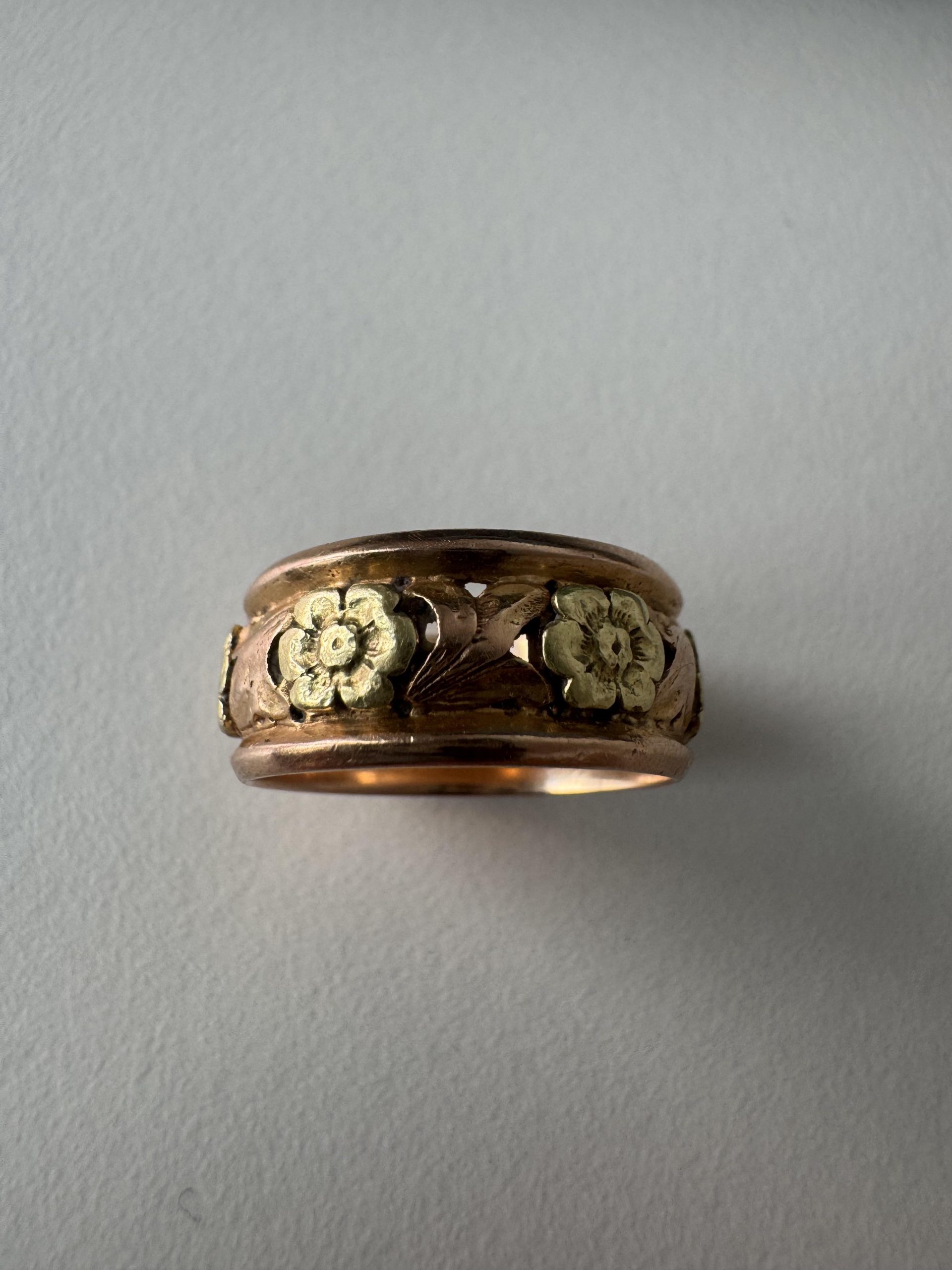
What Collectors Should Know About the Orange Blossom Ring Company
Few American jewelry makers of the early twentieth century still command the loyalty that Traub Manufacturing Co. does, and fewer still are better known by a product line than by their own name. Founded in Detroit in 1910, the firm built its reputation on a single bridal design so successful that collectors and dealers now simply call it the orange blossom ring company. By the mid-1910s the Orange Blossom line of engagement rings and wedding bands had become one of the most recognizable names in American bridal jewelry. It was also, almost immediately, one of the most imitated, and that history still shapes what buyers need to look for a century later.
A motif borrowed from a royal wedding
Traub did not invent the association between orange blossoms and marriage. Queen Victoria wore a wreath of them at her wedding in 1840, and the fashion spread quickly through the English-speaking world. The flower carried a settled symbolic vocabulary of purity, innocence, and fertility, which gave it staying power well beyond a passing trend.
What Traub contributed was translation into metal. The company is said to have worked from casts taken of actual blossoms, and the resulting garlands have a specific botanical accuracy that generic floral motifs of the period lack. Once you have handled a few genuine examples, the difference in the flower heads becomes easy to see.
What set the rings apart
The line was produced in platinum, 18 karat gold, and 14 karat gold, and the rings were die-struck rather than cast. That matters to condition. Die-striking compresses the metal and produces dense, durable work with crisp interior edges, which is a large part of why so many hundred-year-old examples survive in wearable shape.
The blossoms themselves were hand chased into the metal rather than simply stamped in and left, giving the garlands depth and shadow that photographs rarely capture. The line eventually extended beyond bridal sets for women; by 1928 the company was offering wedding rings for grooms as well.
Imitated from the beginning
Success brought imitation fast. By the early 1920s the design was being copied widely enough that Traub responded with advertising aimed directly at consumers. A May 1923 advertisement in the Saturday Evening Post instructed shoppers to examine the inner surface of any ring before buying, on the reasoning that the marks inside the shank were the only reliable proof of origin.
That remains the correct advice. A genuine piece should carry both the Orange Blossom name and the Traub maker’s mark, a letter T within a circle, alongside the metal designation such as PLAT, 18K, or 14K. A floral ring bearing neither mark may still be an attractive antique, but it is not a Traub, and it should not be priced as one. Many surviving pieces also carry a hand-engraved wedding date inside, which is a useful corroborating detail and often a charming one.
Why authentic examples are scarce
The company was sold in 1990, and the American Orange Blossom molds were destroyed shortly afterward, ending production of the line as it had existed. A Canadian licensee, however, retained duplicates of some original molds, and a Toronto buyer acquired that operation in 2003 and produced rings from them.
This creates a distinction worth understanding. A ring can be struck from genuine original molds and still be a modern piece rather than an antique. The molds establish the design lineage; the hallmarks, the metal standards, the wear patterns, and any interior engraving establish the age. Ask a seller to address both.
Buying one now
Examine the same things you would on any piece of this age. Check whether prongs have been retipped, whether the shank has been replaced, and whether the ring can be sized at all, since fully decorated bands often cannot be resized without disturbing the pattern. Ask for the maker’s marks in writing, and ask what restoration has been done.
If you would like to see how period pieces are examined and documented before they are offered, browse the current collection at Gesner Estate Jewelry, where each ring is hand selected and evaluated. A design that survived a century of imitation is worth taking the time to identify correctly.
