

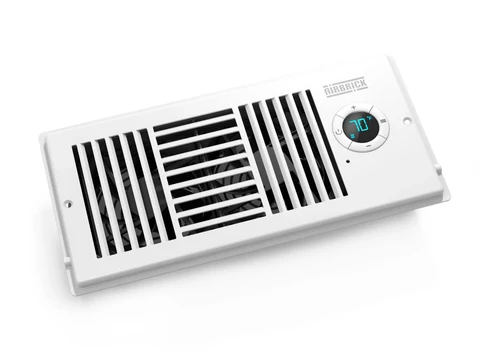
A bedroom that stays cold in winter or a home office that becomes too warm in summer may point to weak airflow at the register. In many homes, register booster fans can provide a practical way to pull more conditioned air into rooms that receive less airflow than the rest of the property. They fit over or replace an existing register and support the forced-air system without requiring major duct modifications.
Why Do Some Rooms Receive Less Airflow?
Uneven heating and cooling can have several causes. A room may be far from the furnace or air handler, connected to a long duct run, located above a garage, or affected by several turns in the ductwork. Additions and converted spaces may also have registers that receive less airflow than rooms near the HVAC equipment.
Other possible causes include:
- Closed or blocked dampers
- Dirty filters
- Leaking or poorly insulated ducts
- Incorrectly sized ductwork
- Furniture covering a register
- An HVAC system that is not properly balanced
Contractors should check for these issues before recommending an airflow accessory. A booster fan can support airflow at a specific register, but it cannot repair damaged ducts or correct an improperly sized HVAC system.
How Does a Register Booster Fan Work?
A register booster fan uses built-in fans to draw additional heated or cooled air from the supply duct into the room. It is installed at the register opening, where it assists the airflow already produced by the central HVAC system.
Some models use a temperature sensor to detect when heated or cooled air reaches the register. The fans then start automatically and shut off when the heating or cooling cycle ends. This reduces the need for homeowners to operate the unit manually throughout the day.
The result is more air entering the problem room during normal HVAC cycles. This can help reduce noticeable temperature differences between rooms while keeping the existing forced-air system in place.
When Is a Booster Fan a Good Recommendation?
Register booster fans are most useful when the central system operates correctly but one or two rooms receive weaker airflow. Common applications include:
- Second-floor bedrooms
- Rooms above garages
- Home additions
- Finished basements
- Converted attics
- Home offices
- Rooms at the end of long duct runs
For HVAC contractors, these products can provide a focused answer when a customer is not ready for major duct changes. Builders and remodeling contractors may also consider them when changes to room layouts affect air distribution.
A booster fan should not be presented as a cure for every comfort complaint. If several rooms are affected, the contractor may need to inspect system capacity, duct sizing, return-air pathways, insulation, and overall air balance.
What Should You Check Before Installation?
Begin by measuring the register opening rather than the outside dimensions of the existing grille. The replacement unit must match the duct opening and be approved for the intended floor or wall position.
Next, inspect the register and accessible duct area for debris or visible damage. Confirm that the damper is open and that nearby furniture, curtains, or rugs will not restrict airflow.
The electrical cord must also reach a suitable outlet without creating a trip hazard. Avoid running the cord beneath rugs or placing it where furniture could pinch or damage it. Always follow the manufacturer’s placement, electrical, and operating instructions.
How Can Contractors Set Proper Expectations?
Explain that the fan assists airflow at one supply register. It does not increase the heating or cooling capacity of the central equipment. Results can vary based on duct pressure, room size, insulation, window exposure, and the condition of the HVAC system.
Contractors can test airflow and record the room temperature before installation. A follow-up reading after installation gives the homeowner a clearer picture of the change. This also helps determine whether other comfort issues require attention.
Homeowners should keep the register clear and clean dust from the fan area as directed. They should also replace HVAC filters on schedule because a heavily restricted filter can reduce airflow across the entire home.
A Practical Addition to an Airflow Assessment
Uneven temperatures often require careful diagnosis rather than a single standard repair. Once equipment faults, duct problems, blocked registers, and insulation concerns have been addressed, a register booster fan may offer a straightforward way to support a problem room.
HVAC professionals, builders, inspectors, and homeowners can visit Suncourts to review available airflow products and find a register booster option suited to the room, installation location, and existing forced-air system.
