

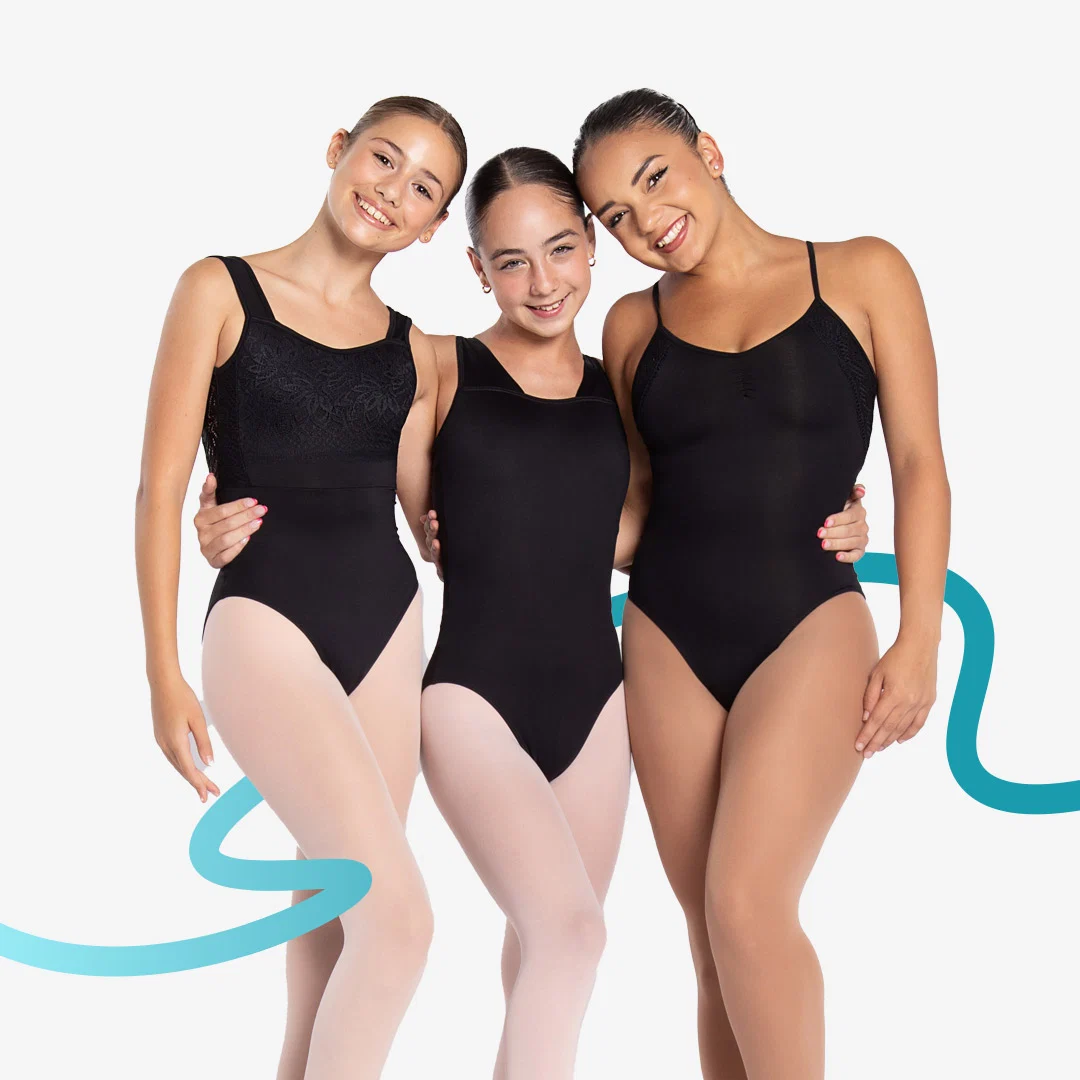
What a Ballet Leotard Has to Do, and How to Check Whether It Does It
The close fit of a leotard is often assumed to be a matter of tradition or appearance. It is neither. A teacher correcting technique needs to see the working of the body: where the ribs sit, whether the shoulders are down, where rotation is initiating, whether the weight is genuinely over the supporting leg. Loose fabric hides exactly the information the correction depends on. Judging ballet leotards well means asking whether a garment does that job while staying comfortable enough that you forget about it, and a few specific checks answer that faster than trying things on ever will.
The measurement almost nobody takes
Leotards are sized by girth, not by chest or waist. Girth is measured from the top of one shoulder, straight down the front, through the crotch, up the back, and back to the same shoulder.
This is why so many leotards fit badly for reasons that seem inexplicable. A dancer with a long torso can be entirely correct on every other measurement and still find that every leotard pulls down at the shoulders, rides at the leg openings, and feels like it is compressing them from above. The fix is not a different style. It is a larger size, chosen on girth, even though the rest of the measurements suggest otherwise.
Take the measurement with a soft tape, standing straight, and check it against the brand’s chart rather than assuming your size carries across brands. It rarely does.
Straps: the difference between a good class and a distracted one
The test is simple. Raise both arms overhead, roll through the shoulders, and go to the floor and back up. Anything that slips will slip in every class, and each adjustment costs a moment of attention you would rather give the combination.
Camisole straps look elegant and vary enormously in how well they stay put; adjustable ones solve most of the problem. Cross-back and racerback constructions are the most secure by design, since the crossing point stops lateral travel entirely. Wider straps distribute pressure better over long rehearsals than thin ones.
Lining, gusset, and opacity
Three construction details that separate a garment worth owning from one that disappoints in month two.
Front lining matters for coverage and for how the fabric sits. Double lining is worth seeking out in pale colors, where single-layer fabric frequently goes translucent under stretch and studio lighting. Test this yourself: stretch the fabric across your hand and hold it up to a light before you commit.
A cotton gusset is a hygiene feature rather than a luxury, and its absence is noticeable in any garment worn for hours at a time.
Fabric behavior
You want three things: enough stretch to move without resistance, enough recovery to return to shape after class rather than staying distorted, and moisture handling that keeps the garment consistent from barre to the end of centre.
Matte and brushed finishes tend to wear more discreetly than high-shine ones, which show every mark. Mesh panels add breathability where the body runs hottest, though they need the same opacity check as anything else.
What happens next
Leotards are outgrown far faster than they are worn out, particularly through adolescence, and a drawer of good garments that no longer fit is the normal end state rather than an unusual one.
Resale and trade-in have become the sensible answer. Tiger Friday, which manufactures its range in small batches in the United States, runs a trade-in program that accepts gently used dancewear from any brand, not only its own, in exchange for store credit. Programs like it keep serviceable garments in circulation and take some of the sting out of the growth years.
Measure girth, test the straps in motion, hold the fabric to the light, and most of the guesswork disappears.
