

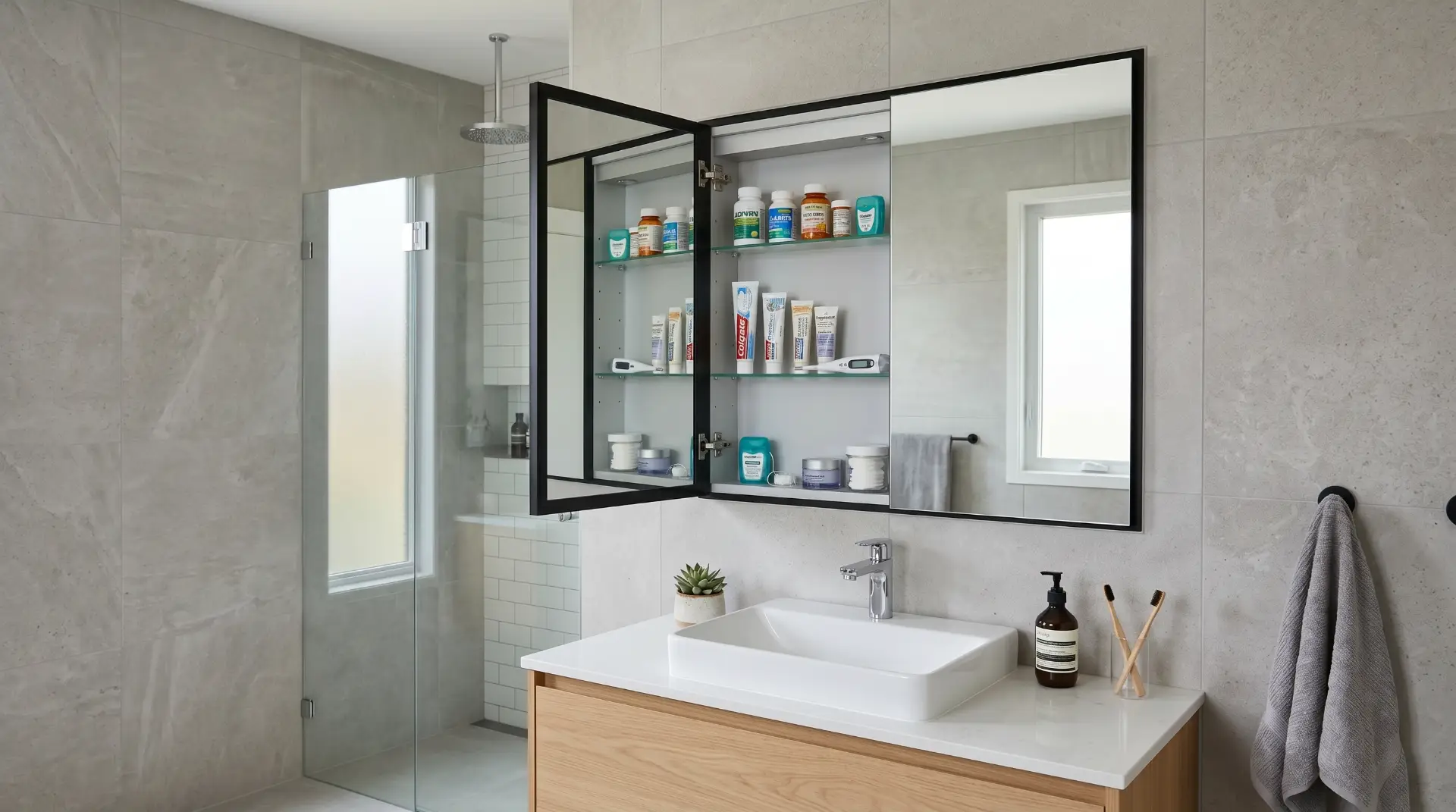
The mirror above your sink gets used more than any other surface in the house. It is also, in most bathrooms, doing nothing else. A mirrored medicine cabinet asks that same square footage to hold your daily products as well, which is why it remains the most efficient upgrade available in a room where nothing is ever quite big enough.
The catch is that this is one of the few fixtures that has to succeed at two unrelated jobs at once. Get the storage right and a bad mirror will annoy you every morning. Get the mirror right and shallow, fixed shelving will leave your counter as cluttered as it was before. The specs below are the ones that decide which way it goes.
Start with size, not style
Most returns in this category come down to dimensions rather than looks. Measure before you shortlist anything.
- Width: the cabinet should be narrower than the vanity beneath it, not wider. A common guideline is to stay a few inches inside the vanity edge on each side so the proportions read deliberately.
- Height off the counter: leaving roughly 4 to 8 inches between the vanity top and the bottom of the cabinet keeps the backsplash clear and gives you room to set things down.
- Eye line: the center of the mirror should sit near the eye level of the people using it most. In a household with a big height spread, a taller mirror solves more than a perfectly centered one.
- Door swing: check what the open door hits, including a sconce, a shower curtain, or an adjacent wall in a narrow bathroom.
Recessed or surface mount
This is a structural decision and it limits everything downstream, so make it early.
Recessed cabinets sit inside the wall cavity and finish close to flush.
- Standard framing on 16-inch centers gives you roughly 14.5 inches of clear width between studs
- A 2×4 wall provides about 3.5 inches of usable depth
- Plumbing stacks, vent lines, and wiring often sit exactly where you wanted the box
- Best choice in a tight bathroom where a projecting cabinet would catch elbows
Surface mount cabinets fasten to the finished wall and project four to six inches into the room.
- Installation is far simpler and the wall stays intact
- You can go wider and deeper than a stud bay allows, which means real storage capacity
- The projection is barely noticeable in a normally sized bathroom
If you do not know what is behind the wall, a stud finder and a small inspection hole in a spot you will cover anyway settles it in ten minutes.
The mirror details people overlook
Two cabinets can look identical online and behave completely differently once they are on the wall.
- Door configuration: a single door is the simplest. Double doors suit wider openings. A tri-view gives you angled side panels, which is the only practical way to see the back of your own head.
- Interior mirroring: mirrored backs and inner door panels make the cabinet feel deeper and let you check a side profile with the doors open.
- Edge treatment: beveled edges read traditional, while a flat polished edge or frameless design reads modern and is easier to wipe down.
- Glass quality: look for a copper-free, moisture-resistant mirror backing. Cheap silvering in a humid room develops black spotting at the edges within a few years.
- Anti-fog: a heating element behind the glass keeps a usable section clear while the shower runs. It is optional, but it is the feature people miss most once they have lived with it.
Storage that earns its keep
The cabinet body is where cost cutting hides, because almost nobody inspects it before buying.
- Adjustable shelves matter more than shelf count. A bottle of mouthwash and a tube of toothpaste have nothing in common dimensionally, and fixed spacing wastes the difference.
- Soft-close hinges and magnetic catches sound trivial until you live with a door that slams at six in the morning.
- Material: stainless steel or aluminum bodies handle a room that runs humid twice a day better than particleboard, which swells at the edges over time.
- Interior power: some models include built-in outlets and USB-A or USB-C ports, so an electric toothbrush and a razor charge inside the cabinet instead of on the counter. Confirm ETL or UL certification on anything electrical.
- Depth check: measure your tallest regular item before assuming a shallow recessed unit will work. A standard shampoo bottle will not fit in a 3.5-inch cavity.
A short checklist before you order
Run through this once and most of the common regrets disappear.
- Measure the wall opening, the vanity width, and the ceiling clearance, and write all three down
- Decide recessed or surface mount based on what is genuinely in the wall, not on preference alone
- Confirm the door swing clears every fixture nearby
- Check whether the model needs hardwiring, and whether a junction box already exists
- Read the installation documentation before purchase rather than after the box arrives
- Verify the return window and what the return costs you if the unit does not fit
Support is worth more than a small price difference on a fixture you are cutting into a wall for. Retailers such as Allsumhome that publish detailed installation guidance and offer engineer support by phone make this a realistic weekend project, and a well-chosen mirrored medicine cabinet will keep paying you back in counter space every morning for years.
