

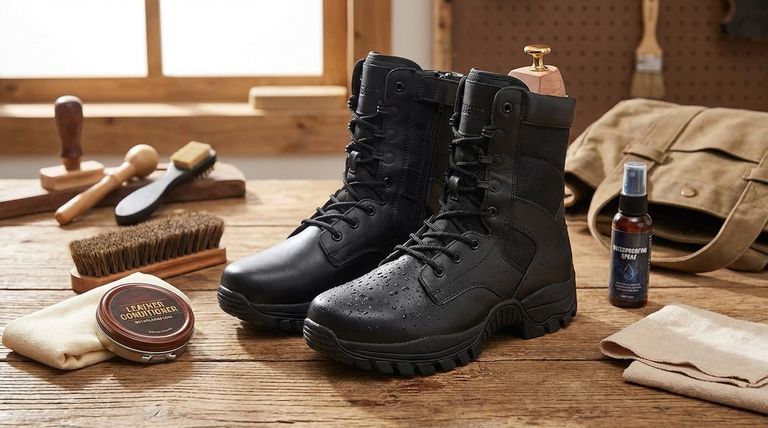
Bates boots are built to last — but built to last and actually lasting are two different outcomes, and the difference between them is almost always maintenance. A pair of Bates boots constructed from full-grain leather and Goodyear welt construction has the material and structural capacity to perform reliably across a decade or more of professional use — but only if the leather is conditioned consistently, the outsoles are replaced before structural damage occurs, and the boots are stored and dried in ways that preserve rather than degrade their construction integrity. For men and women who have invested in Bates footwear as a professional tool rather than a disposable commodity, understanding how to maintain that investment correctly is as important as the purchasing decision itself.
This guide covers every dimension of Bates boot care — cleaning, conditioning, waterproofing, drying, storage, and resoling — with the specific detail that produces genuinely extended boot life rather than the vague guidance that most care instructions provide.
Why Maintenance Matters More for Quality Boots
The instinct to invest maintenance effort proportionally to boot cost is correct — but the reasoning behind it is worth making explicit. A budget boot built from corrected-grain leather and cemented construction has a finite working life that maintenance can extend marginally but not fundamentally alter. A quality Bates boot built from full-grain leather and Goodyear welt construction has a working life that maintenance can extend dramatically — from the two to three years that neglected boots of equivalent quality typically deliver to the eight to twelve years that consistently maintained boots regularly achieve.
The economics of this extension are straightforward. A well-maintained pair of Bates boots that lasts ten years costs a fraction per year of use of a neglected pair that lasts three — and delivers superior performance throughout that extended life because maintained leather retains its structural integrity, weather resistance, and support characteristics rather than progressively degrading toward failure.
Maintenance is not optional for quality boots. It is the mechanism through which their quality is realized.
Cleaning: The Foundation of Every Maintenance Routine
Effective boot maintenance begins with effective cleaning — removing the dirt, salt, moisture, and contaminants that accelerate leather degradation before they have time to work. Cleaning frequency should match use intensity — daily use in demanding environments warrants cleaning after every shift; lighter use warrants cleaning weekly or whenever visible soiling accumulates.
Remove laces and insoles before cleaning. Laces trap dirt at the eyelets and prevent thorough cleaning of the tongue and upper vamp area. Insoles retain moisture and odor that cleaning the exterior alone does not address — removing and airing them separately after every shift extends their useful life and maintains interior hygiene.
Remove dry dirt before applying any liquid. Brushing dried mud and dirt from the upper with a stiff-bristled boot brush before introducing any moisture or cleaning product prevents grinding abrasive particles into the leather surface during the cleaning process. A boot brush is the single most important tool in a boot maintenance kit — use it before every other cleaning step.
Clean with appropriate products for the leather type. Full-grain leather uppers — the standard across Bates’ professional range — respond well to saddle soap or dedicated leather cleaner applied with a damp cloth, worked into the leather in circular motions, and wiped clean with a separate damp cloth. Suede and nubuck uppers require dry brushing and specialized suede cleaners — water-based cleaning products used on suede cause permanent surface damage. Patent leather requires only a damp cloth and occasional patent leather conditioner — standard leather care products disrupt the patent finish.
Address salt stains immediately. Road salt and sweat salt are among the most damaging contaminants for leather — they draw moisture from the leather fibers as they dry, causing stiffening, cracking, and surface discoloration that becomes progressively harder to reverse with time. A solution of equal parts white vinegar and water applied to salt-stained areas immediately after exposure neutralizes the salt before it can cause structural damage.
Conditioning: Keeping Leather Alive
Leather is a natural material that requires regular replenishment of the oils that keep its fiber matrix flexible, strong, and weather resistant. Every cleaning cycle, every exposure to wet conditions, and every day of wear in dry environments depletes these oils to some degree — conditioning replaces them and maintains the leather’s functional and structural integrity across years of use.
Condition after every cleaning. The cleaning process itself removes surface oils alongside the dirt it targets — conditioning immediately after cleaning restores what cleaning has depleted and prevents the drying cycle from drawing additional moisture from the leather fibers.
Choose conditioner appropriate to the leather and use environment. Mink oil provides deep conditioning and significant water resistance enhancement — appropriate for boots used in consistently wet environments but darkens light-colored leather permanently and can soften structured leather components if applied excessively. Leather cream conditioners provide effective conditioning without significant color change or softening — the appropriate choice for most professional Bates boot applications. Beeswax-based conditioners provide conditioning alongside a degree of water resistance and surface protection — appropriate for outdoor and field use where a combination of conditioning and protection is needed.
Apply conditioner sparingly and work it in thoroughly. A thin, even coat of conditioner worked into the leather with a clean cloth or applicator brush — paying particular attention to flex points at the vamp and ankle where leather stress is highest — delivers better results than a heavy application that sits on the surface without penetrating. Allow the conditioner to absorb fully before buffing with a clean cloth.
Condition the welt and stitching. The welt — the strip of leather that connects upper to outsole in Goodyear welt construction — and the stitching that runs through it are structural components that benefit from conditioning alongside the upper. Dry, brittle welt leather and degraded stitching thread are common failure points in neglected boots that conditioning directly prevents.
Waterproofing: Protecting Against Moisture Damage
Bates boots used in wet conditions — rain, snow, standing water, or high-humidity environments — require waterproofing treatment in addition to conditioning to prevent the moisture penetration that causes leather to stiffen, swell, and eventually crack as it dries.
Understand the difference between water resistance and waterproofing. Conditioned and wax-treated leather provides water resistance — it sheds light precipitation and brief moisture contact without penetration. Full waterproofing — the level needed for extended exposure to wet conditions or standing water — requires either a waterproof membrane construction built into the boot or regular application of a waterproofing product that fully seals the leather surface.
Apply waterproofing treatment to clean, conditioned leather. Waterproofing products applied to dirty or dry leather seal contaminants into the surface and penetrate unevenly — producing inconsistent protection and potentially trapping moisture against the leather rather than excluding it. Clean and condition before every waterproofing application.
Reapply waterproofing regularly. Waterproofing treatments deplete with wear, cleaning, and UV exposure — typically requiring reapplication every four to eight weeks under regular use conditions, or immediately after any cleaning cycle that involved significant moisture exposure. A simple water bead test — dropping water onto the treated surface and observing whether it beads or absorbs — indicates when reapplication is needed.
Drying: The Step Most Damaging When Done Wrong
Wet boots dried incorrectly suffer more damage from the drying process than from the moisture exposure itself. Direct heat — radiators, forced air heaters, direct sunlight, and campfires — dries leather too rapidly, causing the fiber matrix to contract unevenly and producing the stiffening, cracking, and adhesive failure at seams that most wearers attribute to water damage rather than improper drying.
Dry at room temperature away from direct heat. Remove insoles, loosen laces, and place boots in a well-ventilated area at room temperature — allowing them to dry naturally over twelve to twenty-four hours. This rate of drying allows the leather fibers to release moisture gradually without the structural disruption that rapid heat drying causes.
Use boot trees or newspaper to maintain shape during drying. Wet leather is temporarily plastic — it conforms to whatever shape it dries in. Cedar boot trees maintain the boot’s correct last shape during drying while absorbing excess interior moisture. Crumpled newspaper provides a lower-cost alternative that absorbs moisture effectively — replace it every few hours as it saturates.
Condition immediately after drying. Dried leather has lost a portion of its natural oils to the evaporation process — conditioning immediately after the boot has fully dried restores these oils before the leather has time to stiffen at the flex points where cracking typically initiates.
Storage: Protecting Boots Between Use Periods
Boots stored incorrectly between use periods — whether overnight or across seasonal gaps — deteriorate in ways that regular use would not produce. The storage environment and preparation both affect long-term boot condition:
Clean and condition before any extended storage period. Boots stored dirty accumulate contaminant damage across the storage period — salt, mud, and organic material continue degrading leather even when the boots are not being worn. Cleaning and conditioning before storage ensures that the leather enters the storage period in its best possible condition.
Store in a cool, dry, ventilated environment. Humid storage environments promote mold growth on leather — particularly on boots stored while retaining interior moisture. Direct sunlight fades and dries leather finishes. Plastic bags and sealed containers trap moisture and prevent the air circulation that leather requires to remain stable across storage periods. Boot bags made from breathable fabric provide dust protection without moisture trapping.
Use boot trees for long-term storage. Cedar boot trees maintain last shape, absorb residual moisture, and provide the cedar oil vapor that deters the insects and mold that can damage leather during extended storage periods. For boots stored seasonally, boot trees are a worthwhile investment in preservation.
Resoling: Extending Working Life Beyond the Original Outsole
Goodyear welt construction — the standard in Bates’ professional boot range — allows boots to be resoled when the outsole wears without replacing the upper or lasting components that represent the majority of the boot’s value. Resoling at the appropriate time extends boot working life significantly and converts what would be a boot replacement expense into a minor maintenance cost.
Resole before structural damage occurs. The appropriate time to resole is when the outsole has worn to the point of reduced traction effectiveness — before wear reaches the welt or midsole components that resoling cannot address. Waiting until the outsole is completely worn through risks damage to the welt that makes resoling impractical and forces full boot replacement rather than the simple outsole swap that earlier action would have allowed.
Use a cobbler experienced with Goodyear welt construction. Resoling Goodyear welt boots requires specific equipment and technique — not every cobbler has the capacity to handle welt construction correctly. Confirming cobbler experience with welt boots before committing a quality pair of Bates boots to the resoling process prevents the damage that inexperienced resoling can cause to the welt and upper components.
The Boot That Rewards the Effort Put Into It
Quality footwear and consistent maintenance have a compounding relationship — each conditioning session, each correct drying cycle, and each timely resoling extends the boot’s working life and preserves the performance characteristics that made the original investment worthwhile. For men and women who depend on their Bates boots professionally, that compounding relationship is one of the best returns available on any footwear investment.
BootsPlusMore carries the full Bates range alongside the care products — conditioners, waterproofing treatments, boot trees, and cleaning supplies — needed to maintain that investment correctly. Explore the full collection and give your Bates boots the care that their construction deserves.
